
Hedge Trimming Service: What to Expect and How to Book Well

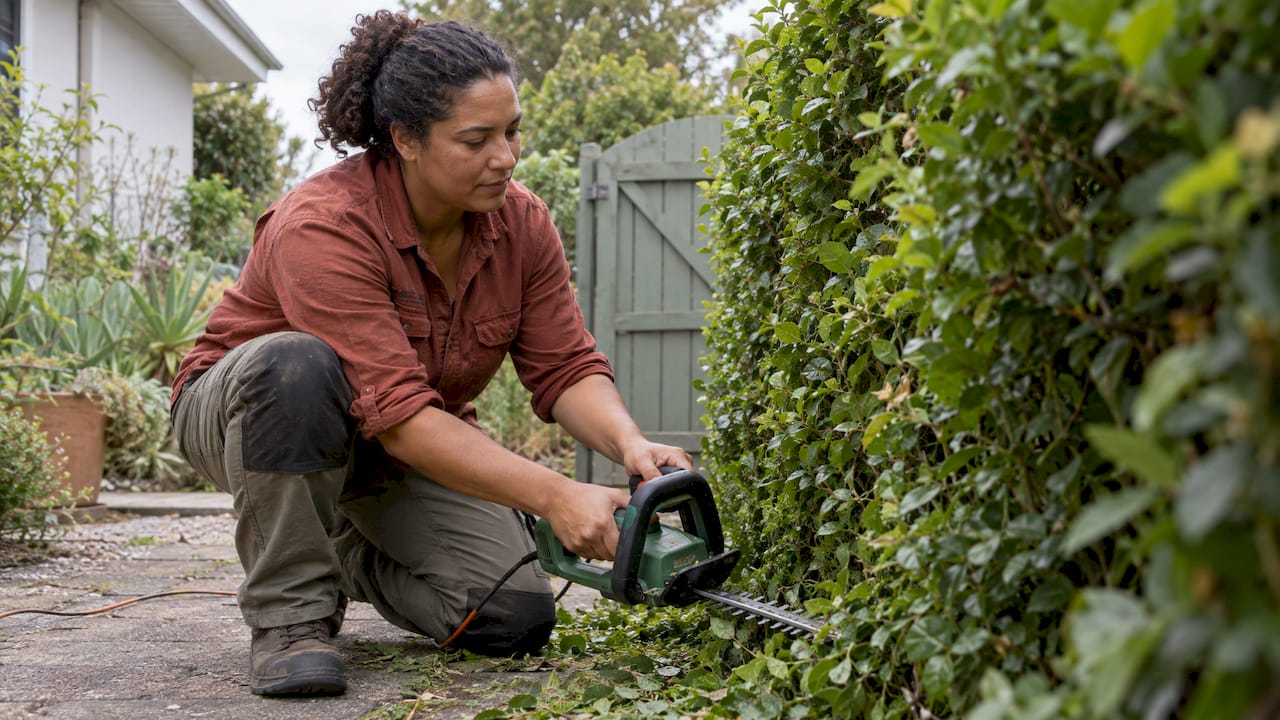
A good hedge trimming service leaves you with a clean, even hedge, a tidy site and a plant that is healthier after the cut than before it. The way to get that is to book at the right time of year, give the crew a clear brief, and have the work quoted on the actual hedge rather than on a guess. For homes and commercial properties in Wollongong, Shellharbour, Kiama, Berry and the wider Illawarra and Shoalhaven, our team at On Common Ground Landscapes looks after ongoing garden maintenance and planting, and we quote after seeing the site.
This guide covers what a trimming visit includes, when to cut common hedge types, what drives the price, how to prepare, and how to decide who should do the job.
TL;DR
Most evergreen hedges are best trimmed in late winter to early spring, with a lighter shape-up in summer. Check for nesting birds before any summer cutting.
Trimming keeps a hedge to its shape. Pruning and renovation cut deeper into the plant and are done in stages.
Price depends on length, height, access, plant type and how much waste leaves the site, so a quote on the real hedge beats any per-metre figure.
Clear access, mark delicate plants and tell the crew what shape you want before the visit.
Hedges above ladder height carry real fall and electrical risks, so work at height belongs with trained people.
Table of Contents
What a hedge trimming service actually includes
A standard visit covers cutting the sides and top of the hedge to a set line, removing the clippings and leaving paths and garden beds clear. That is the baseline. Everything else is a variation on it.
The words people use overlap, so it helps to separate them:
Trimming is the regular light cut that holds an established hedge to its shape. Done twice a year on fast growers, it takes only the new growth.
Shaping sets or changes the form: a flat top, a slight taper wider at the base, a curved or sculpted line. It usually needs a first cut that is more careful than a routine trim.
Pruning is cutting for the plant’s health and structure, such as removing dead wood, thinning dense growth so light reaches the inside, or cutting back to a branch junction.
Renovation is reducing an overgrown hedge hard. It is done in stages and is a different job from a tidy-up.
When you ask for quotes, say which of these you are after. A “trim” on a hedge that has doubled in size is really a reduction, and the time involved is very different.
When to trim hedges in Australia
Timing matters more than most people expect, because cutting at the wrong time costs you flowers or leaves the hedge open to stress.
STIHL Australia’s hedge guide recommends trimming evergreen hedges in late winter to early spring, deciduous hedges in late winter while dormant, and spring-flowering hedges straight after they flower. It also notes that lilly pilly and photinia need at least one trim a year, while boxwood and murraya need at least two.
On the Illawarra coast, where lilly pilly, murraya, photinia and the occasional box hedge are common along fence lines and driveways, that gives a simple calendar:
Hedge type | Main trim | Second trim |
Lilly pilly, photinia | Late winter to early spring | Optional light shape in summer |
Murraya, boxwood | Late winter to early spring | Mid to late summer |
Spring-flowering shrubs | Straight after flowering | Light tidy later if needed |
Deciduous hedges | Late winter while dormant | Only if growth is vigorous |
Birds and nesting
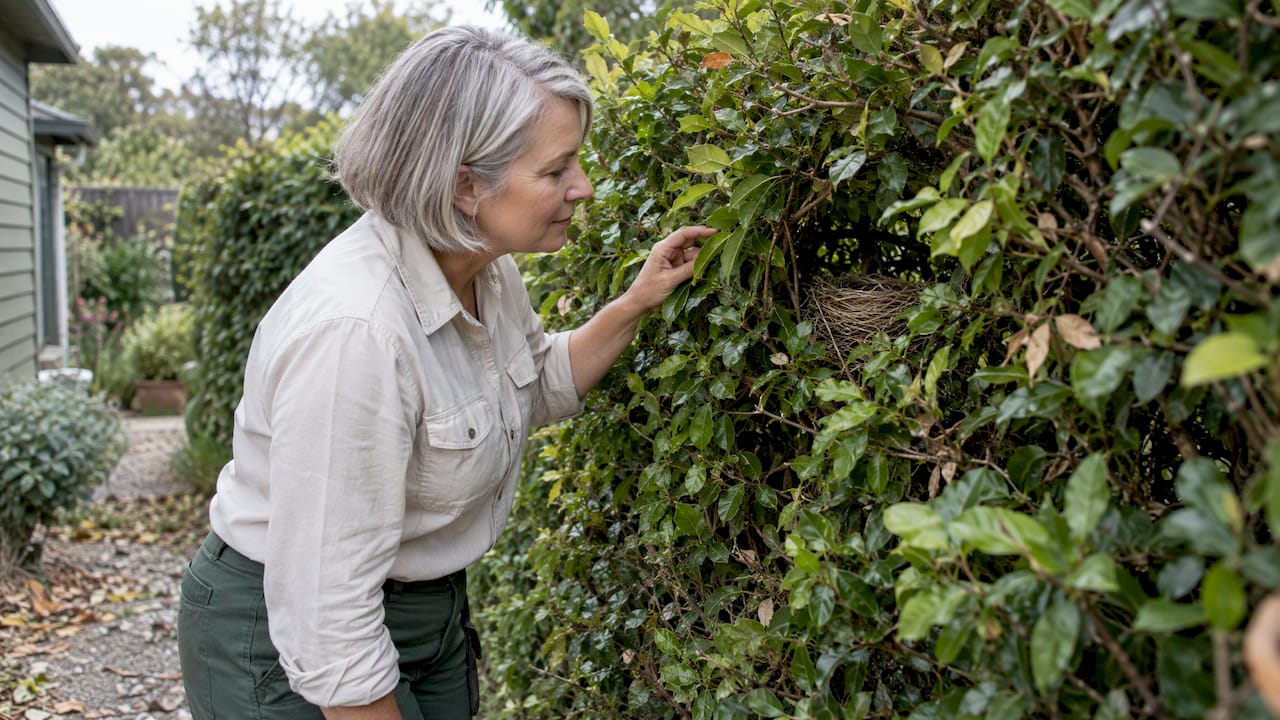
STIHL’s guidance also says to check for breeding bird nests before light summer shaping, with the nesting window running from September to March. A crew that checks the hedge first protects wildlife and keeps you out of an awkward situation. If you see a nest, leave that section until the chicks have gone.
How much to take off
Husqvarna Australia recommends trimming twice a year because new growth is easier to cut, and taking no more than 20% of the hedge in one session and 30% in a season. A broader Australian guide from Leafy Heaven sets a one-third rule: avoid removing more than a third of a plant’s foliage at once, and bring an overgrown hedge back across two or three seasons. After a heavy cut it suggests deep watering, a balanced fertiliser and mulch through the first two to three weeks of recovery.
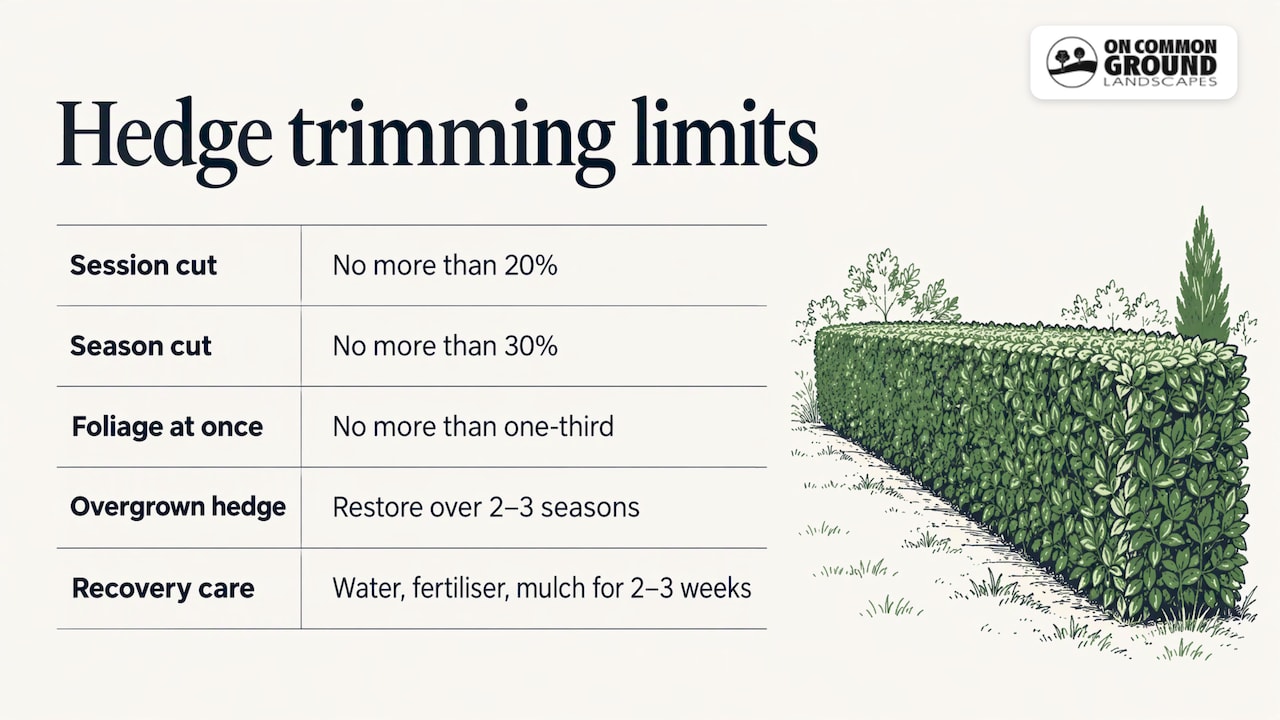
The practical point: a hedge that has been left for years cannot be brought back to a tidy box in one visit without risking brown, bare patches. A staged plan gives you a better hedge in the end.
What affects the price of hedge trimming
Hedge trimming is almost always quoted by the job, and two hedges of the same length can price very differently. These are the factors that move a quote:
Length and height. More hedge means more time, and anything taller than a person can reach from the ground changes the equipment and the safety set-up.
Width and density. A thick, deep hedge takes longer to cut and produces much more waste than a slim one.
How overgrown it is. Cutting back growth from several seasons is slower, more careful work than a routine trim.
Plant type. Fine-leaved hedges that need hand finishing take longer than coarse ones trimmed with a powered trimmer.
Access. Steep blocks, narrow side passages, a neighbour’s fence and no vehicle access all add time. Much of the Illawarra is sloping, so access is worth mentioning when you enquire.
Clippings. Taking everything away costs more than leaving it with you for mulching or the green bin.
Frequency. A hedge on a regular schedule stays lighter and quicker to cut than one visited once every few years.
Per-metre and hourly figures circulate online, but they mix cities, hedge sizes and what is included. The reliable way to price your hedge is to have someone look at it, measure it and write down what the quote covers. When you compare quotes, compare the inclusions: cleanup, waste removal, height, and the number of visits.
Our approach is built on transparent quoting after a site visit, so you see what the job involves before you agree to anything.
How to prepare for a hedge trimming visit
A little preparation shortens the visit and improves the result. A green waste guide from a Perth supplier suggests keeping access paths clear, pointing out delicate plants or new mulch, and flagging any heavier branches or tangled growth. Those points apply anywhere. Here is the routine we would follow:
Clear the path. Move bins, pots, hoses and outdoor furniture away from the hedge line, and make sure the crew can reach both sides.
Show the shape you want. Flat top or rounded, straight or tapered, how high. A photo helps. If you are unsure, ask for a slight taper, wider at the base, which lets light reach the lower leaves.
Point out what to protect. New plantings, fresh mulch, irrigation lines, lights and anything growing through the hedge.
Mention boundaries. If the hedge sits on or over a fence line, tell the crew. Talk to your neighbour beforehand if the other side needs access.
Decide what happens to the clippings. Taken away, or left in a pile for you. Hedge clippings cut into small pieces can go in a council green bin, but large volumes rarely fit.
Check for nests. Between September and March, have a look yourself and tell the crew what you saw.
For more general pointers on getting a property ready before a trimming visit, these hedge trimming tips cover cutting technique and cleanup.
For property managers and business owners
If you look after a block, a rental or a commercial frontage, add two things to the brief. First, agree access times with tenants or staff, so the crew is not working across a car park at peak hours. Second, set a schedule. Hedges at a shopfront or a strata complex show their condition immediately, and a regular visit twice a year keeps a hedge in shape for far less effort than catching up after it has run wild. Ongoing maintenance is one of the services we offer, which suits properties that want the same people on site each season.
Safety: when a hedge is more than a weekend job
Powered hedge trimmers cause serious injuries. Safe Work Australia’s guide to managing the risks of tree work lists the hazards of powered hedge trimmers: blade contact, overhead electric lines, falling debris, falls from height and vibration. Its control measures include:
operating the trimmer with two hands
pre-start checks on the machine
gloves, eye, head, hearing and foot protection
avoiding electric trimmers in wet conditions unless they are protected by a residual current device (RCD)
checking the other side of a tall hedge before cutting
Husqvarna adds a handling point: sweep the trimmer upwards rather than pushing it down, because if it snags it is safer to pull the tool towards you than drive it towards your leg. It also says never to run the trimmer one-handed or force it through thick branches.
The same Safe Work Australia guide stresses that risks around work at height call for a high level of competency, and that people should seek advice from a competent person such as a qualified arborist. If your hedge is taller than you can safely cut from the ground, or runs near power lines, call a qualified arborist rather than climbing a ladder with a trimmer.
Doing it right the first time: what a good result looks like
When the cut is done properly you can see it:
The top is level and the sides are even, with no steps or scalloped patches.
The hedge is slightly wider at the bottom than the top.
Leaf cutting is clean rather than shredded, which is a sign of sharp blades and a steady pace.
The base and the edges of the bed are clear, with no clippings on the lawn or in the mulch.
There are no sudden bare patches from over-cutting.
Ask the crew how they plan to handle the first cut on an overgrown hedge. A clear answer about staging the work across seasons tells you they are thinking about the plant, not only the day’s job.
Hedges as part of a bigger garden plan
A hedge is a structural element. It screens a boundary, softens a retaining wall, frames a driveway or hides a drainage run. If yours is failing, or the garden around it has changed, trimming is only part of the answer.
It is worth thinking about:
Replacing a tired hedge. Gaps, dieback at the base or constant disease are signs that new planting will serve you better than another trim.
Edging and mulch. A crisp garden edge and fresh mulch under a trimmed hedge finish the look and suppress weeds. Garden edging and mulching are both part of what we do.
Irrigation. Hedges recovering from a heavy cut need consistent water, and an irrigation line takes the guesswork out.
Drainage and walls. Hedges planted at the foot of a wall or on a slope need water to move away properly. Our drainage solutions and retaining walls work often sits alongside planting for that reason.
If you want the whole outdoor space to work together, our garden care, design and makeovers page sets out how we approach it.
Having us look after your hedges
We have been working in gardens across the Illawarra and Shoalhaven since 2012. Our work is tailored to each site and to how the people who use it live, and our clients get clear communication, transparent quoting and direct access to experienced hands throughout the project. For hedges, that means we start with a site visit, talk through the shape and the schedule, and quote on what we see.

Our planting, mulching, irrigation, garden edging, garden makeovers and ongoing maintenance services are described on our main site. If you are in the area, our local pages for Wollongong, Kiama, Gerringong and Berry and Shellharbour and Shell Cove show the kind of work we do close to you. Send us the address, a photo of the hedge and what you want it to look like, and we will arrange a quote.
FAQ
How often should a garden hedge be trimmed?
Most fast-growing hedges need at least one trim a year, and many do better with two. Husqvarna Australia recommends trimming twice a year because new growth is easier to cut. Lilly pilly and photinia need at least one trim, and boxwood and murraya at least two, according to STIHL Australia.
What is the best time of year to trim a hedge?
For evergreen hedges, late winter to early spring is the main window. Spring-flowering hedges are cut after they flower, and deciduous ones in late winter while dormant. If you shape a hedge in summer, check for nests first, as breeding season runs from September to March.
How much does it cost to trim a large hedge?
The price depends on length, height, thickness, access, how overgrown the hedge is and whether clippings are removed. Because those factors vary so much, the dependable number comes from a quote after someone has seen the hedge. Ask what the quote includes, particularly cleanup and waste removal.
Can I cut an overgrown hedge back in one go?
It is better not to. Removing more than about a third of the foliage at once risks bare patches that may not regrow. A staged reduction over two or three seasons, with watering and mulch after each cut, gives a denser hedge in the end.
What happens to the clippings?
That is something to settle when you book. Small amounts cut into short pieces can go in a council green bin. Larger volumes are normally removed by the crew, which should be stated in the quote.
Sources
Recommended
Comments